
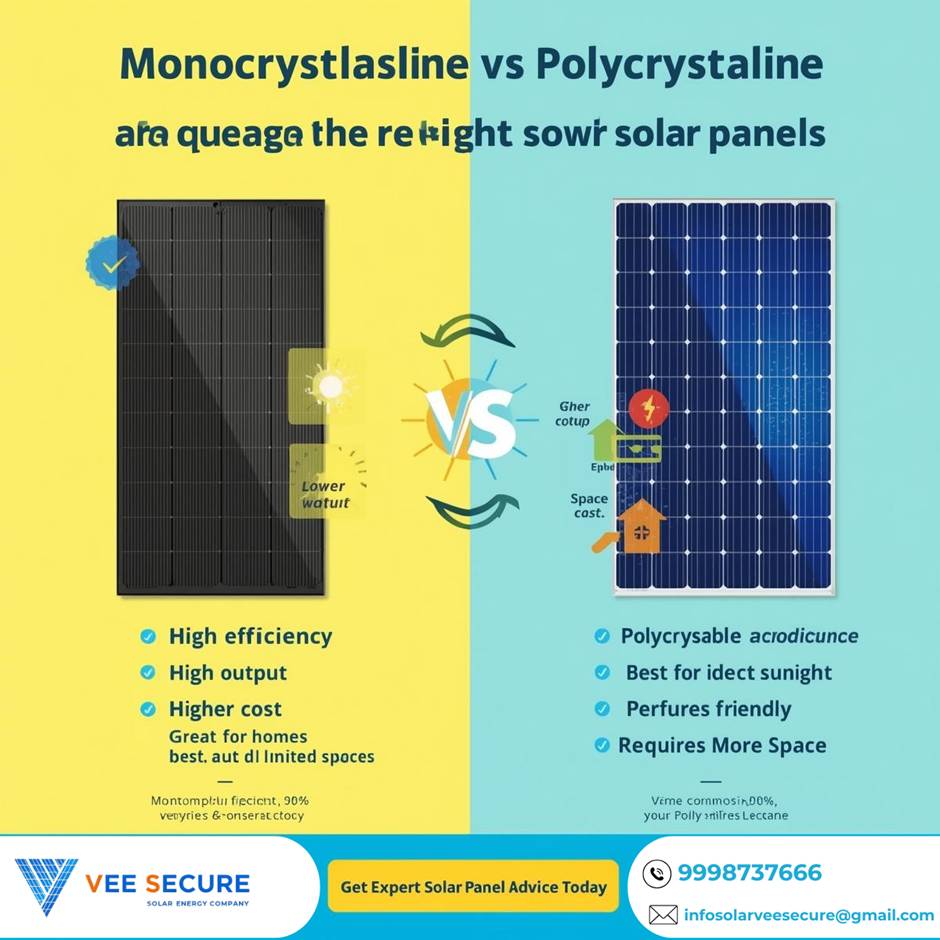
When planning to go solar, one of the most important decisions you’ll face is choosing the right type of solar panel. Among the different technologies available, monocrystalline and polycrystalline panels are the two most widely used. Both have unique strengths, costs, and applications, and the choice depends on your energy goals, budget, and available roof space.
This guide breaks down the differences, benefits, drawbacks, and ideal use cases of both panel types so you can make a confident, well-informed decision.
- 🌞 What Are Monocrystalline Solar Panels?
Monocrystalline solar panels, often called mono panels, are made from a single continuous crystal structure. The silicon used in these panels is of high purity, which makes them stand out in terms of efficiency and appearance.
Appearance: Typically black in color with rounded edges.
Material: Made from a single silicon crystal.
Efficiency Range: 17–22%.
Mono panels are considered the premium option in solar technology due to their higher efficiency and sleek look.
- 🔆 What Are Polycrystalline Solar Panels?
Polycrystalline solar panels, also known as poly panels, are made by melting multiple fragments of silicon together. This results in a panel that has a blue-speckled appearance.
Appearance: Blue color with a shattered glass-like pattern.
Material: Made from multiple silicon fragments melted together.
Efficiency Range: 13–17%.
Poly panels are generally more affordable than mono panels, making them a popular choice for homeowners on a tighter budget.
- ⚡ Efficiency Comparison
Efficiency is one of the biggest factors when choosing solar panels.
Monocrystalline Panels: With efficiencies of up to 22%, they generate more electricity per square meter. This makes them ideal for homes with limited roof space.
Polycrystalline Panels: Slightly lower efficiency (13–17%), meaning they require more surface area to produce the same amount of energy as mono panels.
👉 If space is limited, monocrystalline panels are the smarter choice. If you have plenty of roof area, poly panels can still meet your energy needs effectively.
- 💸 Cost Difference
Budget plays a key role in solar adoption.
Monocrystalline Panels: More expensive due to higher manufacturing costs and superior efficiency.
Polycrystalline Panels: Less costly, making them a great option for those looking to minimize upfront investment.
👉 If you’re focused on long-term ROI and premium quality, go for mono. If affordability is your main concern, poly is the way to go.
- 🌱 Lifespan and Durability
Both types are built to last, but there are slight differences:
Monocrystalline: Lifespan of 25–30 years with very slow degradation.
Polycrystalline: Lifespan of 20–25 years with slightly faster performance degradation.
👉 Both come with manufacturer warranties, but mono panels may give you a longer effective return period.
- 🔋 Performance in Different Conditions
Performance varies depending on sunlight, temperature, and environment.
High Heat: Mono panels perform better in hot climates as they are less sensitive to high temperatures.
Low Light: Mono panels again outperform poly panels, generating more electricity even during cloudy days.
Ample Sunlight & Space: Poly panels can work well in areas with consistent sunlight and plenty of roof area.
- 📐 Space Requirement
Monocrystalline: Since they are more efficient, fewer panels are needed for the same energy output. Great for smaller rooftops.
Polycrystalline: Require more panels and more roof space to match the output of mono panels.
👉 For compact rooftops, mono is the winner. For large open roofs, poly can be a cost-effective solution.
- 🌍 Environmental Impact
Both types of panels are environmentally friendly, but their production has some differences:
Monocrystalline: Manufacturing results in more silicon waste.
Polycrystalline: Production uses silicon fragments, leading to less material wastage.
👉 If sustainability in manufacturing is important to you, poly panels may be slightly greener.
- 🏠 Best Use Cases
Monocrystalline Panels are best suited for:
Urban homes with limited roof space.
Premium projects where aesthetics matter.
Hot climates and areas with frequent cloudy weather.
Businesses seeking long-term high returns.
Polycrystalline Panels are best suited for:
Rural or semi-urban areas with large rooftop space.
Budget-conscious homeowners.
Installations where upfront cost is the main concern.
Large commercial projects where land/roof space is abundant.
- 📊 Side-by-Side Comparison
| Feature | Monocrystalline | Polycrystalline |
|---|---|---|
| Efficiency | 17–22% | 13–17% |
| Appearance | Black, sleek, uniform | Blue, speckled pattern |
| Cost | Higher upfront price | Lower upfront price |
| Space Requirement | Less space needed | More space needed |
| Lifespan | 25–30 years | 20–25 years |
| Best For | Limited roof area, premium choice | Large roof area, cost-conscious buyers |
- 🔮 Hybrid Approach
Some solar buyers mix technologies depending on their property layout and budget. For example, mono panels on shaded/smaller rooftops and poly panels on larger open areas. EPC companies can customize such hybrid solutions for maximum performance at the right cost.
- ✅ Final Thoughts
Both monocrystalline and polycrystalline panels have proven track records and can deliver excellent results. The choice comes down to your budget, roof space, and energy goals:
Choose Monocrystalline if you want the highest efficiency, premium aesthetics, and long-term returns.
Choose Polycrystalline if you want affordability, reliable performance, and have enough roof space to compensate for lower efficiency.
Either way, solar is not just an investment in cutting energy bills — it’s a step toward a cleaner, greener, and more sustainable future.